
Curriculum Development
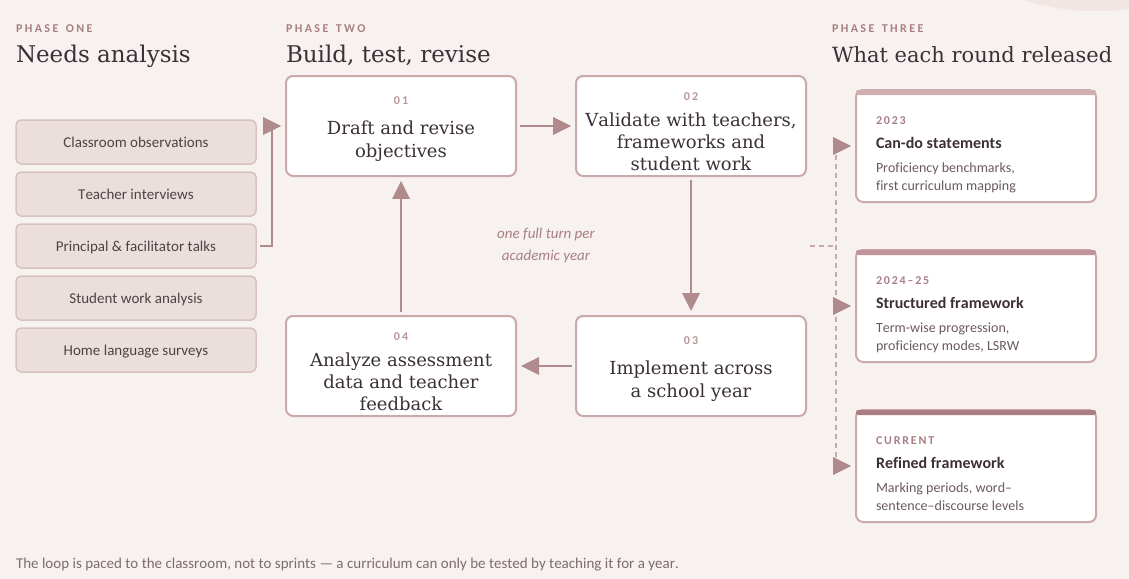
I build curriculum for contexts where no usable framework exists yet. In the Urdu–English immersion program, teachers had been working for years without a shared progression, each drawing on whatever was at hand — English literacy benchmarks, Spanish immersion resources, textbooks written for a different country. My job was to find out what was actually happening across grades, then build something coherent that teachers would recognize and use.
That meant starting with evidence rather than a template: classroom observations, interviews with every grade-level teacher, conversations with school leadership, analysis of student work, and home language surveys. It also meant looking closely at how Urdu itself works: its connected script, right-to-left direction, and reliance on vowel diacritics meant that knowing letters in isolation was not enough to read a word. Existing resources offered useful pieces, but none fit this context exactly, so I adapted what transferred and rebuilt what didn’t. The design then moved through repeated build-and-test cycles: drafting objectives, taking them back to teachers for cross-grade review, validating them against proficiency frameworks and real student work, watching them run in classrooms for a year, and revising based on what came back.
This work involves: needs analysis | cross-grade progression design | standards alignment (ACTFL, NC World Language Essential Standards, WIDA) | iterative prototyping | teacher collaboration and validation | curriculum revision from classroom evidence
Curriculum Writing
Developing a curriculum and writing one are different jobs. Writing is where the decisions get made at the level of the individual line: how an objective is worded, which grade it belongs to, what has to come before it, and how a teacher will read it at eight in the morning while planning a lesson.
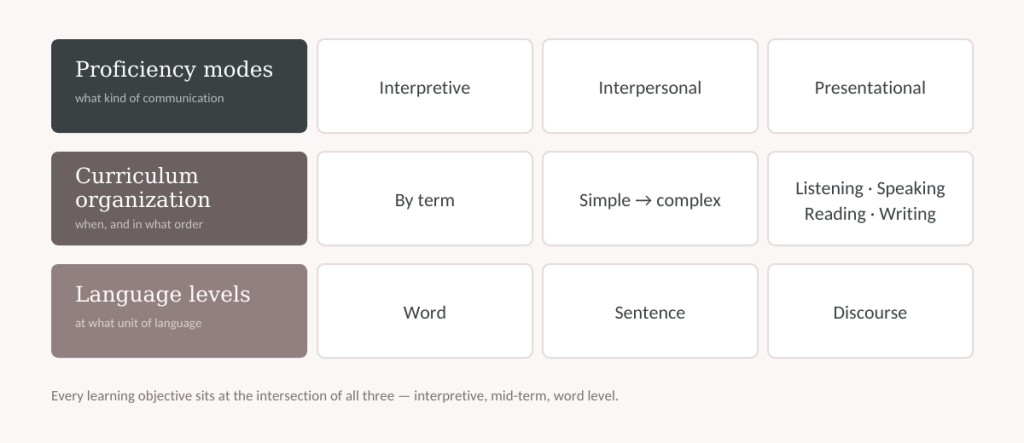
I write teacher-facing curriculum documents. This includes: grade-level learning objectives, can-do statements, proficiency benchmarks, and skill progressions. I organize these documents to be clear, accessible, and easy for teachers to use. In the Urdu work, that meant structuring the framework to mirror documents the school already used, sequencing objectives across marking periods and language levels, tagging each one to the language domains it draws on, and annotating the reasoning behind sequencing choices so teachers could adapt rather than just follow. Writing for a language with a connected script and contextual letter forms also meant that familiar literacy progressions couldn’t simply be translated; each step had to be rebuilt around how this writing system actually behaves.
This work involves: learning objectives and can-do statements | proficiency benchmarks | skill progressions and sequencing | instructional scaffolding | teacher-facing documentation | writing for independent implementation
Assessment Design
I design assessments built from specific learning objectives, so that results show which skill needs attention rather than producing a general score. My work covers task design, scoring, and the evaluation of assessments other people built.
Biliteracy assessment, K–5
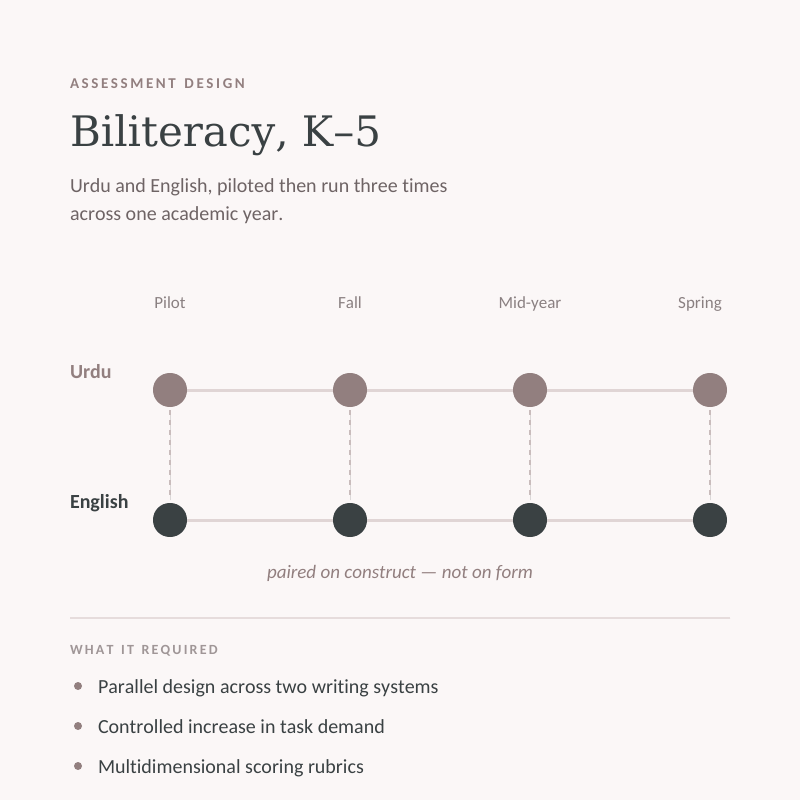
I co-developed parallel literacy assessments in Urdu and English for grades K–5, piloted them, and administered them three times across one academic year to track how the two literacies developed alongside each other. Assessing biliteracy is not the same as assessing two languages separately: the writing systems place different demands on a learner, so an English task and its Urdu counterpart have to be built to measure comparable constructs without assuming the skills transfer. Tasks were sequenced so that
demand increased in a controlled way across the year, and each item isolated the skill it was meant to measure. I also developed multidimensional scoring rubrics drawing on literacy constructs, Science of Reading principles, Scarborough’s Reading Rope, and Depth of Knowledge, so that different raters would read the same performance the same way.
Narrative and reasoning tasks
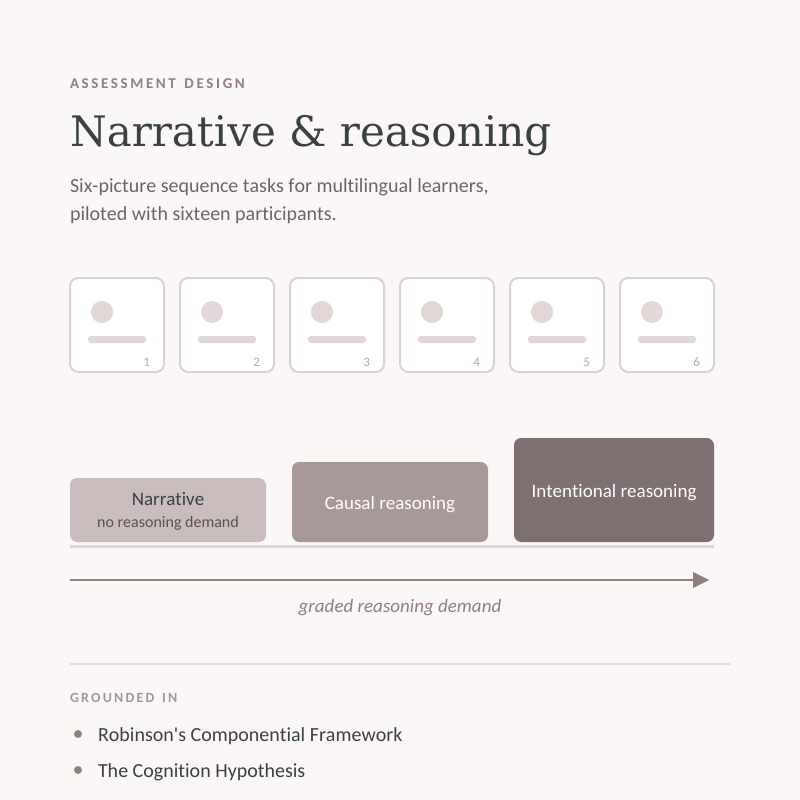
At NALSAR University of Law I contributed to the design and piloting of narrative-based reasoning tasks for multilingual learners, informed by Robinson’s Componential Framework of Task Complexity and the Cognition Hypothesis. Six-picture sequence storytelling tasks were built to examine intentional reasoning, causal reasoning, and narrative comprehension across graded reasoning demands, and piloted with sixteen participants. I also translated and adapted the Multilingual Assessment Instrument for Narratives
from English into Hindi, and co-developed phonological, phonemic, and semantic awareness tasks for Hindi–English bilingual learners drawing on the PPVT and BVAT frameworks. This work is where I learned to hold cognitive rigor and learner accessibility against each other: a task that is too clear stops measuring reasoning, and one that is too demanding stops measuring language.
Assessment evaluation
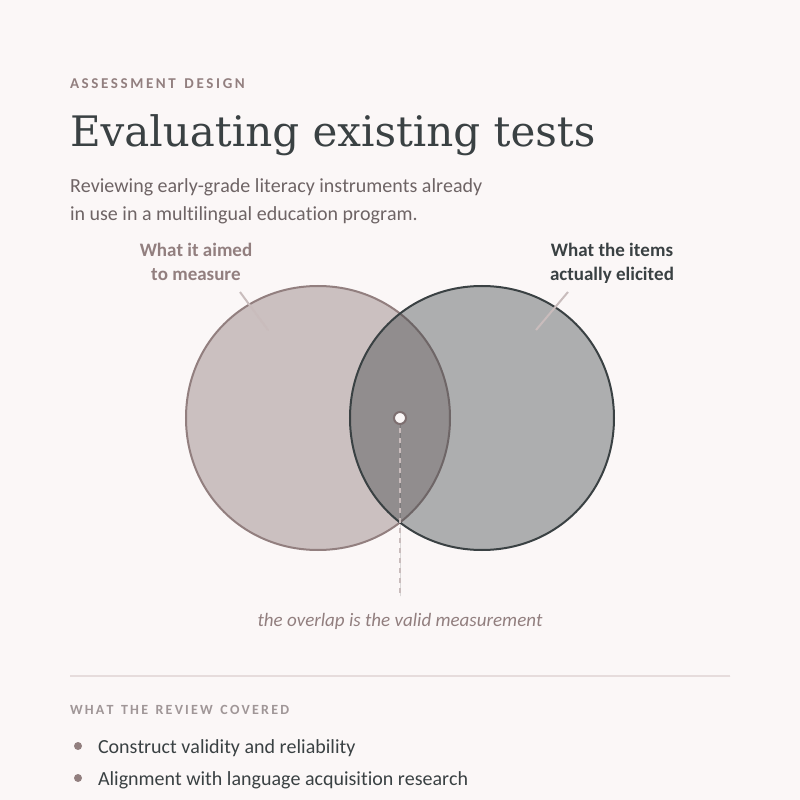
For an NGO running a mother-tongue multilingual education program, I evaluated the early-grade literacy assessments already in use. The analysis identified which skills and constructs the instruments were actually testing, where that diverged from what they were intended to test, and where task design was threatening validity and reliability. I grounded the review in research on language acquisition and early literacy development and returned concrete recommendations for revision.
This work involves: assessment and item design · biliteracy and cross-script assessment · task complexity sequencing · multidimensional rubric development · construct validity and reliability review · narrative and reasoning task design · standards alignment · learner performance analysis
 Homepage